





Eye For Film >> Movies >> Limitation (2023) Film Review


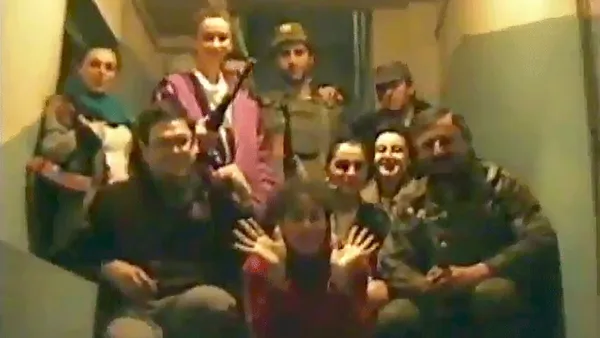

In an assemblage of media images that's a little over two hours long, Georgian directors and professors of audio-visual arts at the Georgian Institute of Public Affairs in Tbilisi Elene Asatiani and Soso Dumbadze unravel their home country's tumultuous years of early independence. Limitation, which just screened at the fifth edition of the Kutaisi International Shorts Film Festival, is a clever, dynamic study of the period that followed the election of Zviad Gamsakhurdia as Georgia's first president since the fall of the Soviet Union in 1991. The archival footage consists of interviews with Gamsakhurdia, television reports from pro-government and pro-opposition media, and various documentary materials covering the country’s state in the early 1990s. The film is a spatial exploration of its capital, too, with Rustaveli Avenue in particular emerging as the backdrop to instances of street unrest.
The form calls for the audience's own reconstructive work when it comes to history as well as its moral judgment. Close to some of the best work of Harun Farocki, Andrei Ujică, or more recently Tomasz Wolski in his A Year In The Life Of A Country (2024), Asariani and Dumbadze leave their footprint on the material almost exclusively through editing, avoiding explicit authorial commentary. The seemingly wide national support for Gamsakhurdia is contrasted with scenes of civilians under gunfire in the streets, while Gamsakhurdia's dead-serious interview is disputed by his own views, articulated once the television camera turns off. Who is he addressing anyway, choosing to speak in Russian from which he easily switches to fluent Georgian whenever he feels like it? Publicly, he claims his views are anti-Soviet. When the lights go out, he says he was instructed to say so.
These and other games of representing oneself and events underline the idea that there is no innocent reading of media content. On the contrary, one should necessarily always doubt it, and seek to see it from another angle -- in the case of early 1990s Georgia, perhaps from that of Gamsakhurdia's political rival Eduard Shevardnadze, the former secretary of the Georgian Communist Party accused of plotting a coup, or that of Tengiz Kitovani, commander of the National Guard, formerly Gamsakhurdia's close ally. Where the directors help in this is in providing brief information on the source of the material. At times, it is channels like Radio Free Europe; in other cases, a public national broadcast. The gathered excerpts should be of interest even to those who witnessed the upheavals in real time. Revisited and re-examined, they shine a new light on the period, in connection to today's challenges, too – Russia's lasting presence in the post-Soviet space being the main one.
The logical absurdities and the shifting notions of reality and truth presented in the film are also shaped by the broader historical context. Limitation transports viewers to an era when journalistic reporting not only flourished but erupted, the Gulf War (1990–1991) took place as a media phenomenon, and reality television was on the rise. The material excavated by Asatiani and Dumbadze offers insights into the power of enduring national narratives, while simultaneously reflecting a larger media landscape; and that is what makes it compelling.
Reviewed on: 07 Oct 2025


